
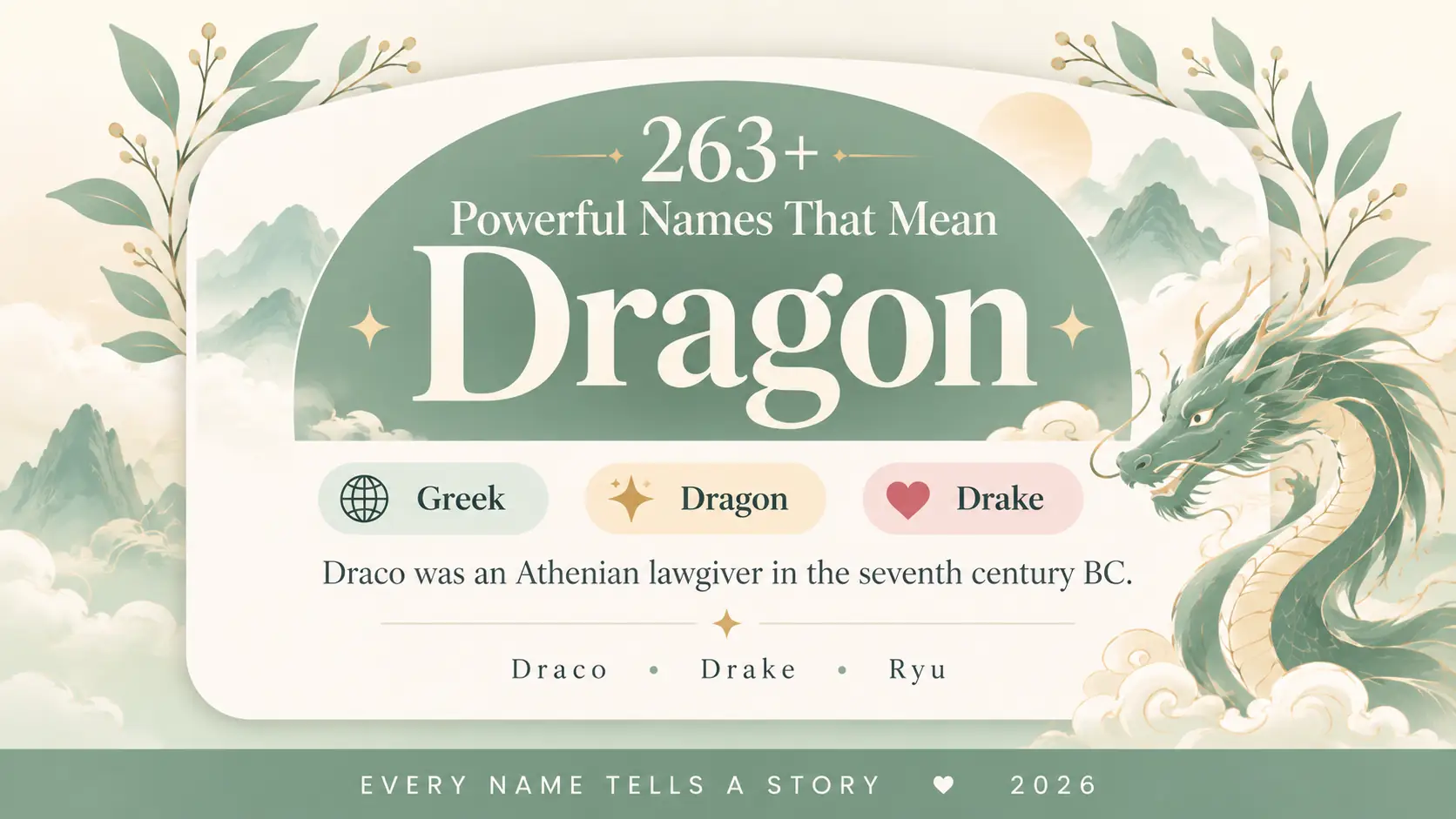
Names That Mean Dragon reach across Ancient Greek, English, Chinese, Vietnamese, and Japanese traditions, where the dragon can represent a serpent, celestial guardian, imperial power, prosperity, or supernatural strength. The oldest firmly documented personal name in this group is Draco, from the Greek drakon, meaning dragon or serpent, borne by an Athenian lawgiver in the seventh century BC.
If you want a dragon name for your little one, the key is knowing which choices literally carry the meaning and which merely have dragon associations. That distinction matters especially with Japanese and Chinese names, where the exact written form can change a name’s meaning.
Names That Mean Dragon from Draco to Ryuu
| Name | Language and core meaning | Naming note |
|---|---|---|
| Draco | Ancient Greek, dragon or serpent | One of the clearest ancient personal names with a literal dragon meaning |
| Drakon | Ancient Greek form, dragon or serpent | The original form behind Latinized Draco |
| Drake | English, from older bynames meaning dragon | Modern surname name with an unusually ancient root |
| Long | Chinese, dragon when written with the dragon character | The same sound can carry other meanings depending on its written form |
| Ryuu | Japanese, dragon with the appropriate character | A direct modern Romanization without diacritics |
| Ryu | Japanese, dragon with the appropriate character | Simplified international spelling of Ryuu |
| Ryuji | Japanese, dragon plus an additional name element in some spellings | Not every written form means dragon |
| Ryunosuke | Japanese, dragon plus possessive and helper elements in one established spelling | Traditional masculine choice |
| Tatsu | Japanese, dragon in certain written forms | Historically used across genders, though modern patterns lean masculine |
| Tatsuya | Japanese, dragon in some written forms | Meaning depends entirely on the characters chosen |
Drake comes through an English surname derived from the Old Norse byname Draki or Old English Draca, both meaning dragon. Those forms ultimately connect with the same ancient Greek dragon word found behind Draco.
How the Ancient Drakon Root Traveled into Modern Names
| Period | What happened |
|---|---|
| Ancient Greek era | Drakon referred to a dragon or great serpent and became the personal name later Latinized as Draco |
| Seventh century BC | Draco of Athens became the earliest famous historical bearer of the personal name |
| Classical and Roman eras | Draco survived in Latin as a dragon term and became associated with the northern constellation |
| Early Germanic period | Related dragon vocabulary entered personal bynames in Old English and Old Norse traditions |
| Medieval England | Draca and related surname forms contributed to what became Drake |
| Arthurian tradition | Dragon imagery became tied to rulers and war leaders through the title Pendragon |
| Modern English naming | Drake moved from surname use into regular masculine given-name use |
| Modern international naming | Draco gained renewed familiarity through astronomy, literature, and fantasy culture |
| Contemporary Japanese use | Ryuu and Ryu remain possible dragon readings, while longer compounds build the dragon element into full given names |
The fascinating part is that Draco and Drake are not modern fantasy inventions. Their dragon connection reaches deep into recorded linguistic history. Draco is directly documented as an Ancient Greek personal name, while Drake inherited its meaning through medieval surname development.
Ryuu Long and the East Asian Dragon Tradition
| Name | Cultural setting | Meaning detail |
|---|---|---|
| Ryuu | Japanese | Directly means dragon with the relevant written form |
| Ryu | Japanese and international | Streamlined spelling of Ryuu often used outside Japan |
| Ryuji | Japanese | Can begin with the dragon element followed by an element such as two or officer |
| Ryunosuke | Japanese | Can combine dragon with elements connected with possession and assistance |
| Ryuto | Japanese | Some forms combine dragon with a constellation element or a word connected with soaring |
| Ryuhei | Japanese | Some forms combine dragon with peaceful, level, or even |
| Ryuko | Japanese | Certain forms can mean dragon child or combine dragon and tiger imagery |
| Tatsu | Japanese | Can mean dragon, although several completely different meanings share the pronunciation |
| Long | Chinese and Vietnamese | Dragon in one major Chinese written form and its related cultural tradition |
| Qinglong | Chinese mythology | Blue-green dragon, the celestial guardian linked with the east and spring |
Ryuu is among the cleanest Japanese choices if your priority is an unmistakable dragon theme, but the written characters are crucial. Japanese names can share the same pronunciation while carrying meanings such as prosperity, achievement, flowing water, precious stone, or dragon.
Long offers the same caution. In Chinese naming, Long can represent dragon, but another character pronounced similarly can mean prosperous or abundant. This gives the spoken name more than one possible interpretation, so cultural and written context should always accompany the English spelling.
Dragon Names Across Cultures and Spellings
| Form | Tradition | What changes |
|---|---|---|
| Draco | Ancient Greek through Latin | Latinized historical form of Drakon |
| Drakon | Ancient Greek | Root form preserving the original final sound |
| Drake | English | Developed through Old English and Old Norse dragon bynames |
| Pendragon | Welsh and Arthurian | Combines the idea of head or chief with dragon |
| Ryu | Japanese | Compact Romanized form commonly recognized internationally |
| Ryuu | Japanese | Longer Romanization that better signals the long vowel |
| Ryunosuke | Japanese | Full compound name with several possible written combinations |
| Ryuji | Japanese | Familiar masculine compound with multiple possible meanings |
| Long | Chinese and Vietnamese | Dragon is one possible culturally important meaning |
| Thang Long | Vietnamese | Means ascending dragon and is historically associated with Hanoi |
Pendragon is especially evocative, although it functions more naturally as a title, surname, or literary-style choice than as an everyday traditional first name. In Arthurian tradition it is associated particularly with Uther Pendragon, the legendary father of King Arthur. The title developed around the ideas of chief and dragon.
Pronouncing Dragon Names without Losing Their Character
| Name | Easy English pronunciation | Practical note |
|---|---|---|
| Draco | DRAY-koh | Familiar and intuitive for most American English speakers |
| Drakon | DRAY-kon | Keeps the harder final consonant of the older form |
| Drake | DRAYK | One syllable and virtually pronunciation-proof in English |
| Ryu | roughly RYOO | Japanese pronunciation is more compact than an exaggerated two-syllable reading |
| Ryuu | roughly RYOO | Same basic name as Ryu, with spelling showing the long vowel |
| Ryuji | roughly RYOO-jee | Smooth three-part rhythm in careful Japanese pronunciation |
| Ryunosuke | roughly RYOO-noh-soo-keh | Four flowing units make it much longer than Drake or Draco |
| Tatsu | TAH-tsoo | Crisp first syllable with a light final vowel |
| Tatsuya | TAH-tsoo-yah | Three rhythmic parts |
| Long | approximately loong in Mandarin | English speakers may initially pronounce it like the English adjective |
If you live in an English-speaking country, Drake and Draco require the least explanation. Ryu also looks beautifully concise, but you may occasionally need to clarify its pronunciation.
Long deserves more cultural care because an English reader is likely to pronounce it exactly like the ordinary English word. Its original Chinese pronunciation is different.
Famous Bearers Who Put These Names on the Map
| Bearer | Name connection | Why the association matters |
|---|---|---|
| Draco of Athens | Draco | Seventh-century BC Athenian lawgiver and ancient historical bearer |
| Drake Graham | Drake | Canadian rapper, singer, and actor widely known simply as Drake |
| Ryunosuke Akutagawa | Ryunosuke | Major Japanese writer whose given name uses the dragon form |
| Tatsuya Fujiwara | Tatsuya | Japanese actor whose written given name uses a dragon character |
| Ryuko Isogai | Ryuko | Japanese actor whose given name demonstrates a masculine dragon-linked Ryuko spelling |
| Uther Pendragon | Pendragon | Legendary Arthurian ruler and father of King Arthur |
| Draco Malfoy | Draco | Fictional bearer who dramatically increased modern recognition of Draco |
| Draco constellation | Draco | Celestial use preserving the ancient dragon designation |
Draco therefore carries two very different kinds of history. One is classical and political through Draco of Athens, while another is celestial through the constellation. Modern readers also recognize it immediately from fiction.
Drake has made the opposite journey. It developed as a surname before becoming a familiar English first name, and contemporary celebrity usage made its sound far more mainstream.
What Current Popularity Says About Drake Draco and Ryu
| Name or pattern | Current evidence | What it tells you |
|---|---|---|
| Drake | Number 827 for US boys in 2025 | Established but no longer highly common |
| Drake in 2024 | Number 659 for US boys | Its rank fell substantially the following year |
| Drake change | Fell 168 ranking positions from 2024 to 2025 | The name is currently cooling in US use |
| Drake peak era | Usage reached its modern high around 2010 | Its strongest American wave came well before 2026 |
| Draco | Outside the US top 1000 in current SSA rankings | Recognizable but distinctly uncommon |
| Ryu | Outside the US top 1000 | Rare in national American data |
| Ryuu | Outside the US top 1000 | Even less familiar as an American birth name |
| Japanese dragon element | Usage can respond to zodiac symbolism | Dragon characters have shown increased interest around Years of the Dragon |
| Long | Established in Chinese and Vietnamese naming | US rank data does not meaningfully represent its wider cultural use |
US Social Security Administration data places Drake at number 827 for boys born in 2025, down from number 659 in 2024. That 168-place decline makes Drake a recognizable choice that is currently far from its earlier peak.
Popularity figures also show why you should not judge this entire category through American charts. Ryu, Ryuu, Long, and compound Japanese dragon names belong to naming traditions whose meaningful usage cannot be summarized by the US top 1000.
Middle Names That Ground a Powerful Dragon First Name
| Pairing | Why it flows |
|---|---|
| Draco James | The classical drama of Draco settles beautifully beside familiar James |
| Draco Alexander | Long Alexander gives short Draco a grand, balanced finish |
| Draco Vincent | Both names feel strong without sounding overly fantastical together |
| Draco Miles | A compact middle keeps the full combination crisp |
| Drake Alexander | The long middle softens Drake’s abrupt one-syllable ending |
| Drake Theodore | Traditional Theodore gives modern Drake more warmth |
| Drake Samuel | The gentle rhythm of Samuel balances Drake’s hard consonants |
| Ryu Alexander | Ryu feels compact while Alexander supplies formal weight |
| Ryu James | Two short names create a clean international combination |
| Ryunosuke Kai | A brief middle gives the longer first name room to breathe |
For dragon-inspired choices, conventional middle names are often the easiest styling trick. A distinctive first name such as Draco can feel much more wearable when the middle is James, Alexander, Thomas, or Vincent.
With a culturally specific name such as Ryunosuke, family heritage should take priority over English rhythm. The most meaningful pairing may be one that honors your language, relatives, or naming tradition.
Sibling Names That Match the Strength without Copying the Theme
- Draco and Orion work together through classical sky imagery without turning both children into literal dragon names.
- Draco and Felix balance an unusual ancient choice with a familiar Latin-rooted companion.
- Drake and Rowan share a modern, nature-friendly surname style with very different sounds.
- Drake and Archer feel brisk and contemporary while avoiding rhyming endings.
- Ryu and Kai create a short, energetic set that travels easily across languages, though you should confirm the cultural meanings important to your family.
- Ryunosuke and Haruto offer distinctly Japanese styling with different rhythms.
- Tatsuya and Kenji pair naturally through established Japanese masculine naming traditions.
- Long and Minh create a compact Vietnamese-style pairing when both names suit your family’s language and heritage.
- Draco and Celeste share a subtle connection with the night sky without matching too closely.
- Drake and Claire make a straightforward English sibling set with equally clean sounds.
Why Draco Feels so Different from Modern Fantasy Inventions
Draco sounds as though a fantasy novelist invented it yesterday, yet its documented history stretches back more than 2,500 years. The Athenian lawgiver Draco lived in the seventh century BC, and his name came directly from a word connected with dragons and serpents.
That age gives Draco surprising substance. If you love mythical imagery but dislike names created purely for modern fantasy, Draco gives you both drama and a genuine historical foundation.
Why Dragon Means More than Fire and Ferocity
Western fantasy often presents dragons as dangerous, treasure-guarding beasts. That imagery explains why Draco, Drake, and Pendragon can sound fierce, guarded, bold, and commanding to English-speaking parents.
East Asian traditions add very different layers. Dragons may symbolize authority, prosperity, cosmic order, rainfall, good fortune, or imperial dignity. A name built from a dragon character therefore does not automatically carry the aggressive feeling an English speaker might expect.
Choosing a Dragon Name without Losing Its Real Meaning
Start by deciding whether you want a name that literally means dragon or one that simply evokes dragon mythology. Draco and Drake have well-established etymological connections, while Ryu and Ryuu can carry the literal meaning when written with the appropriate Japanese character.
With Japanese and Chinese choices, pronunciation alone is not enough to establish meaning. The written character determines whether a sound represents dragon, prosperity, achievement, flowing water, or another idea entirely.
The Sweet Spot Between Mythic and Wearable
Drake is probably the easiest stylistic bridge between ordinary contemporary naming and dragon symbolism. Its one-syllable form fits naturally beside names such as Blake, Luke, Cole, and Grant, even though its historical roots are unusually vivid.
Draco, Ryu, Ryunosuke, Long, and Tatsu offer increasingly distinctive directions. Your best choice depends on whether you want ancient European history, streamlined English style, Japanese naming tradition, or East Asian dragon symbolism.
Faqs About Names That Mean Dragon
Does Draco really mean dragon?
Yes. Draco is the Latinized form of the ancient Greek Drakon, meaning dragon or serpent.
Does Drake mean dragon or male duck?
Its personal-name history comes from older bynames meaning dragon, while the modern English word drake meaning male duck has a separate origin.
Does Ryu always mean dragon in Japanese?
No. Ryu can represent dragon, but other written characters with the same pronunciation can carry completely different meanings.
How popular is Drake for boys in the United States?
Drake ranked number 827 for US boys born in 2025, falling from number 659 in 2024.
Is Draco older than Drake as a personal name?
Yes. Draco is documented through the seventh-century BC Athenian lawgiver, while Drake developed much later through Old English, Old Norse, and surname traditions.