
Names that mean green come from surprisingly diverse roots, from the Greek idea of a fresh green shoot to Japanese, Albanian, Vietnamese, Chinese, Arabic, Celtic, and Scottish words connected with green color, vegetation, and green water. If you want a name for your little one that suggests renewal, spring growth, calm landscapes, or the richness of living plants, you have choices far beyond modern color words.
Some names literally translate to green, while others preserve older meanings such as pale green, blue green, green shoot, or green water. The distinctions matter, especially when you want a name with an authentic cultural story rather than a loose color association.
Chloe, Midori, and Blerta Carry the Clearest Green Meanings
| Name | Root and core meaning | Naming character |
|---|---|---|
| Midori | Japanese, literally green in one established name form | Bright, direct, unmistakably botanical and colorful |
| Blerta | Albanian, from a word meaning green | Rare internationally, crisp and distinctly Albanian |
| Chloe | Greek, green shoot or young spring growth | Familiar, feminine, ancient, and strongly tied to renewal |
| Chloris | Greek, from chloros, meaning pale green or fresh green | Mythological and highly unusual today |
| Khadra | Arabic, feminine form connected with green | Traditional feminine choice with a vivid color meaning |
| Lakhdar | Arabic, green | Established masculine name in North Africa |
| Ao | Japanese, can carry a blue or green meaning depending on its written form | Very short and used for more than one gender |
| Aoi | Japanese, can mean blue green in one established written form | Modern sounding and used for both sexes |
| Thanh | Vietnamese, may express a blue green or clear quality depending on its written origin | Used across genders and especially familiar in Vietnam |
| Irving | Scottish place and surname name ultimately associated with green water | Traditional masculine choice with an indirect green meaning |
Green does not represent exactly the same idea in every linguistic tradition. Chloe describes tender plant growth rather than the color alone, while Midori and Blerta can express green much more directly.
That difference gives you useful choices. You might favor Chloe if you love the symbolism of spring, Midori if you want a true color name, or Irving if you prefer an established masculine name whose green connection sits quietly beneath the surface.
From Greek Chloros to Albanian Green Words
| Name | Language path | What the original sense contributes |
|---|---|---|
| Chloe | Ancient Greek | A green shoot, especially fresh vegetation appearing in spring |
| Chloris | Ancient Greek | Pale green, fresh, or greenish vegetation |
| Blerta | Albanian | Directly linked with the color green |
| Midori | Japanese | The ordinary concept of green when the name uses the corresponding meaning |
| Ao | Japanese | A color range that can include blue and green |
| Aoi | Japanese | Depending on its written form, a plant name or a blue green color sense |
| Khadra | Arabic | Green, verdant, or feminine green imagery |
| Lakhdar | Arabic | Green, particularly in an established masculine naming tradition |
| Irving | Brythonic through a Scottish place name | Green water, preserved through the River Irvine and surname Irving |
| Verda | English usage with uncertain origin | Often linked to Spanish verde, green, though its exact formation is uncertain |
If precise etymology matters to you, Chloe, Midori, Blerta, Chloris, Khadra, Lakhdar, and Irving offer especially clear historical pathways. Verda deserves a little more caution because sources do not fully agree on how the modern given name developed.
Ao and Aoi need another kind of caution. Japanese names can have different meanings depending on how they are written, so their Latin-letter spellings alone do not guarantee that green is the intended meaning.
Ancient Vegetation Goddesses and the Green Water of Scotland
| Period | Green name development |
|---|---|
| Ancient Greek world | Chloe was already used as an epithet connected with Demeter and fresh plant growth |
| Ancient Greek mythology | Chloris appeared as a vegetation figure whose name comes from the idea of pale or fresh green |
| First-century Christian era | Chloe appears in the New Testament, giving the ancient Greek name an enduring biblical connection |
| Medieval Scotland | Irvine developed as a Scottish place name associated with the River Irvine and an older green water meaning |
| Medieval and later Britain | Irving developed from the Scottish surname and place-name tradition |
| Early modern England | Chloe returned to wider English naming use after the Protestant Reformation |
| Nineteenth and twentieth centuries | Irving became an established American masculine given name, including among Jewish American families |
| Twentieth-century Japan | Midori became internationally recognizable through prominent Japanese bearers |
| Late twentieth century | Chloe surged across Britain, the United States, and other English-speaking countries |
| Twenty-first century | Aoi, nature names, color names, and internationally portable short names gained broader attention outside their home cultures |
Chloe has the longest continuously recognizable story among the familiar choices here. Its ancient botanical meaning survived mythology, biblical tradition, European revival, and modern fashion without losing the central image of new growth.
Irving traveled differently. It began with landscape and geography, became a surname, and then became a given name. That makes its green meaning more hidden, but no less interesting for parents who enjoy names with layered histories.
How Green Names Cross Cultures and Genders
| Name | Traditional usage | Modern naming nuance |
|---|---|---|
| Chloe | Feminine in Greek, biblical, and European traditions | Firmly feminine in current English usage |
| Midori | Feminine Japanese name | Still primarily feminine |
| Blerta | Feminine Albanian name | Strongly tied to Albanian language and culture |
| Chloris | Feminine mythological name | Extremely rare as a contemporary baby name |
| Ao | Masculine and feminine Japanese usage | One of the most compact genuinely unisex choices |
| Aoi | Feminine and masculine Japanese usage | Internationally appealing but culturally specific in formation |
| Thanh | Masculine and feminine Vietnamese usage | Often appears alone or within compound Vietnamese names |
| Khadra | Feminine Arabic usage | Especially associated with Arabic-speaking and Muslim communities |
| Lakhdar | Masculine Arabic usage | Familiar particularly in Algeria and surrounding regions |
| Irving | Masculine English and Jewish American usage | Vintage today, with a surname-style feel |
For a clearly feminine green name, your strongest historical options include Chloe, Midori, Blerta, Chloris, and Khadra. For a masculine choice, Lakhdar and Irving have much stronger traditional precedent.
Ao, Aoi, and Thanh give you more flexible gender histories. Their meanings can also depend on linguistic details that are lost when the name is written only in English letters, so cultural context remains important.
Chloe Leads the 2025 Popularity Picture
| Name | Recent popularity picture | What it means for a 2026 parent |
|---|---|---|
| Chloe | Number 23 for U.S. girls in 2025 | Familiar without being the number one choice |
| Jade | Number 95 for U.S. girls in 2025, though its literal root refers to the gemstone rather than the color green | Useful if you want green imagery more than a literal green etymology |
| Sage | Number 160 for U.S. girls in 2025 and also used for boys | A botanical green association, but the name itself means the herb or a wise person |
| Olive | Number 197 for U.S. girls in 2025 | Strong green and botanical imagery through the olive tree |
| Irving | Outside the U.S. top 1000 for boys in 2025 | Distinctly uncommon and strongly vintage |
| Midori | Not a mainstream U.S. top-ranking choice | Recognizable internationally but rare in American nurseries |
| Blerta | Rare in current U.S. national data | Best suited to parents seeking a culturally rooted rarity |
| Chloris | Extremely rare in modern English-speaking use | More mythological than fashionable |
| Aoi | Far more established in Japanese naming than American naming | A cross-cultural choice rather than a mainstream U.S. one |
Popularity can help separate names that literally mean green from names that merely look green on a mood board. Chloe is unusual because it combines authentic green etymology with strong mainstream recognition.
Jade, Sage, and Olive are popular nature and color-adjacent alternatives, but their linguistic meanings are not simply green. They belong in the conversation because they create the same visual palette, not because their root words translate directly to that color.
Irving Berlin, Midori Goto, and Chloe Kim Give These Names Familiar Faces
| Bearer | Field | Name connection |
|---|---|---|
| Chloe Kim | Olympic snowboarder | A globally recognizable modern bearer of Chloe |
| Chloe Grace Moretz | Actor | Helped keep Chloe prominent in contemporary American culture |
| Chloe Sevigny | Actor and fashion figure | Gives Chloe an artistic, fashion-forward association |
| Midori Goto | Violinist | One of the most internationally famous bearers of Midori |
| Aoi Miyazaki | Actor | Well-known Japanese bearer of Aoi |
| Aoi Koga | Voice actor | Contemporary Japanese bearer of Aoi |
| Irving Berlin | Songwriter | One of the defining historical bearers of Irving in American culture |
| Irving Stone | Author | Literary bearer of the vintage masculine name Irving |
| Lakhdar Brahimi | Diplomat | Prominent Algerian bearer of Lakhdar |
| Blerta Basholli | Film director | Contemporary Kosovan bearer of Blerta |
Famous bearers can subtly change the impression a name creates. Midori may feel artistic because of violinist Midori Goto, while Irving carries an old American creative energy because of Irving Berlin.
Chloe is different again. It has enough actors, athletes, artists, and public figures that no single bearer dominates the name, which often makes it easier for a child to make a familiar name entirely her own.
Everyday Short Forms and International Variants
- Chloe, Cloe, Khloe work as recognizable spelling relatives. Chloe is the historically standard English spelling, Cloe appears in Italian and Spanish contexts, while Khloe is a modern English variant.
- Chlo and Clo make intuitive informal shortenings for Chloe, although many families simply use the complete two-syllable name.
- Olive and Ollie pair naturally if you love green botanical imagery but want a familiar nickname built in.
- Midori and Mido can work informally, though Midori is already compact enough that many Japanese bearers use it unchanged.
- Irving and Irv form a traditional formal-to-casual pair that reinforces Irving’s mid-century vintage quality.
- Irving and Ving offer a sharper nickname possibility, familiar from actor Ving Rhames, whose given name is Irving.
- Aoi generally needs no shortening because its compact sound is part of its appeal.
- Blerta is also naturally concise, so affectionate household forms are more likely to be personal or language-specific than standardized internationally.
- Lakhdar should usually remain connected to its established cultural pronunciation rather than being reshaped simply to sound more English.
- Chloris has few established modern nicknames, which makes it most attractive to parents who enjoy unusual classical names in full.
Middle and Sibling Pairings for Names That Mean Green
- Chloe June feels light and springlike. The compact middle lets Chloe’s open ending stay crisp rather than overly sweet.
- Chloe Violet pairs the idea of new green growth with a flower color, creating a subtle garden theme without matching sounds.
- Midori Claire balances a distinctly Japanese first name with a short, internationally familiar middle.
- Midori June has an easy three-two syllable rhythm and reinforces Midori’s fresh seasonal feeling.
- Blerta Rose combines an uncommon Albanian first name with a familiar botanical middle that is easy to pronounce.
- Aoi Grace gives the short vowel-rich first name a calm one-syllable finish in English-speaking settings.
- Irving James leans into Irving’s traditional character and has a strong, measured rhythm.
- Irving Leo updates the vintage first name with a shorter, brighter middle.
- Chloe and Daphne work beautifully as sisters because both have authentic Greek botanical histories without sounding matched.
- Midori and Ren make a restrained Japanese-inspired sibling set with contrasting lengths and clean sounds.
Why Names That Mean Green Often Feel Like Names of Renewal
Green is unusually rich as a naming symbol because it is not limited to a single object. You can picture the first shoot pushing through soil, spring leaves opening, moss after rain, an olive grove, or deep green water. That range lets the color suggest freshness without making every green name feel alike.
Chloe captures this especially well. Its oldest sense is not simply a paint-box shade. It evokes a young green shoot, which gives the name a built-in feeling of growth and beginnings that fits naturally with welcoming a child.
Midori and Blerta are more direct. Their green meanings make them satisfying choices if the color itself matters to you, perhaps because of a favorite landscape, birth season, family connection, or personal symbolism.
Choosing Between a Literal Green Name and a Botanical Name
A literal green meaning gives you the strongest etymological connection. Midori, Blerta, Khadra, and Lakhdar belong close to this category, while Chloe and Chloris express specific shades or forms of fresh green growth.
Botanical names create a similar atmosphere without literally translating to green. Olive and Sage are good examples. They immediately suggest green leaves and plants, yet their actual name histories refer to the olive tree and sage plant rather than the color itself.
Jade occupies another middle ground. Most jade people picture is green, so the name has a powerful green image, but Jade comes from the gemstone name. If etymological accuracy matters most, keep that distinction in mind.
Chloe Versus Midori for an International Name
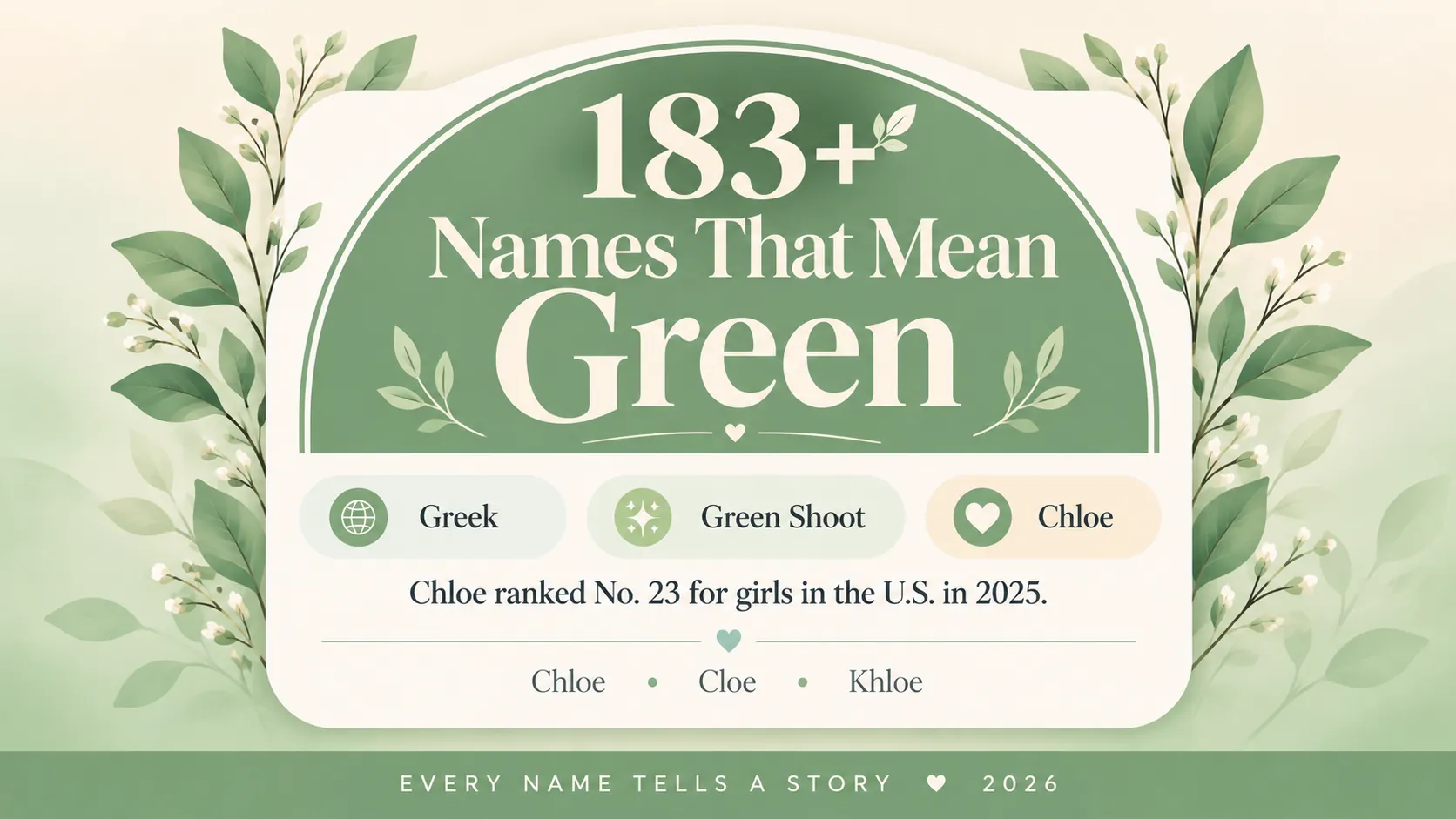
Chloe is easier to carry in most English-speaking communities because it has centuries of Western usage and ranked number 23 among American girls born in 2025. You gain a genuine green-rooted meaning without choosing an unfamiliar name.
Midori offers a more literal color meaning and a distinctly Japanese identity. It is easy for English speakers to read once they know the pronunciation, but its cultural origin remains much more visible than Chloe’s.
Neither approach is inherently better. Your choice depends on whether you want the green story quietly embedded inside a familiar name or clearly expressed through a name strongly connected with its source language.
The Rarest Green Names Have the Strongest Cultural Flavor
Blerta, Lakhdar, Khadra, Chloris, and Midori stand apart from the American mainstream for different reasons. Some are everyday names within their own language communities, while others, especially Chloris, are genuinely rare in modern naming.
That distinction matters when you are judging rarity. A name can be uncommon in U.S. statistics without being unusual in Albania, Japan, Vietnam, or North Africa. Looking at the culture behind the name helps you understand whether you are discovering an ancient rarity or simply meeting a familiar name from another naming tradition.
Faqs About Green Baby Names
Does Chloe really mean green?
Yes, Chloe comes from an ancient Greek word referring to a green shoot or fresh young plant growth.
Does Midori literally mean green in Japanese?
Yes, Midori can directly mean green in Japanese, though Japanese names can also be written in ways that affect their precise interpretation.
Was Chloe still popular in the United States in 2025?
Yes, Chloe ranked number 23 for girls in the 2025 U.S. Social Security baby-name data.
Is Irving really connected with the color green?
Indirectly, yes, because Irving comes from a Scottish place-name tradition tied to the River Irvine and an older meaning of green water.
Which name meaning green works best if you want something uncommon?
Blerta, Midori, Chloris, Khadra, and Lakhdar all offer authentic green connections while remaining far less common in current American naming than Chloe.