
Names That Mean Wild grow straight out of the Old English word wilde, which once described land no plow had ever touched and creatures no hand had ever tamed. If you feel pulled toward that untamed energy, this guide gathers 137 ideas carrying wildness in their roots, from the English surname Wilder to the Swedish Vilda and the Greek Agrios.
You will meet the real people behind these names, their true popularity story, nicknames that keep the spirit, and spellings from three cultures. Thoughtful middle pairings are woven in too, so your final choice feels grounded and joyful.
How the English Word Wild Grew into a Name
| Meaning Layer | Root Language | What It Carries |
|---|---|---|
| Old English wilde | English | The base word for land no one had tamed, the seed of every wild name in this guide |
| Old High German wildar | German | A cousin form that carried the same untamed sense into continental surnames and place names |
| Old Norse vildr | Norse | The Viking age word for wild, the source of the Swedish and Norwegian forms you see today |
| Proto Germanic wildaz | Germanic | The ancient root behind them all, describing whatever lives free from human control |
| Medieval surname le Wilde | English | Given to people who lived near wild country or carried a fierce and fiery temper |
| Wilder as surname | English | Originally marked a hunter of wild animals or a dweller beside the wilderness |
| Wilde as surname | English | A shorter medieval form, later worn with pride by writers, wits, and artists |
| Greek agrios | Greek | The classical word for wild, preserved in the rare mythological name Agrios |
| Wildrose as compound | English | Wild joined to rose, naming the untamed flower that blooms with no gardener at all |
From Medieval Nickname to Modern Birth Certificate
| Era or Century | Development |
|---|---|
| 500s to 1000s | Old English wilde describes uncultivated land and untamed beasts in everyday speech |
| 1100s to 1300s | Surnames like le Wilde appear in English records for families near wild country |
| 1500s to 1700s | Wilder settles as a family name among hunters, foresters, and wilderness dwellers |
| Late 1800s | Wilda blooms in America as a feminine coinage during the nature loving naming fashion |
| Early 1900s | Wilda enjoys its strongest American decades, a vintage favorite of the prairie era |
| Mid 1900s | Wilder shines as a surname of artists and leaders while the first name stays rare |
| 2007 | Wilder begins its first name climb after actress Goldie Hawn becomes a grandmother to a Wilder |
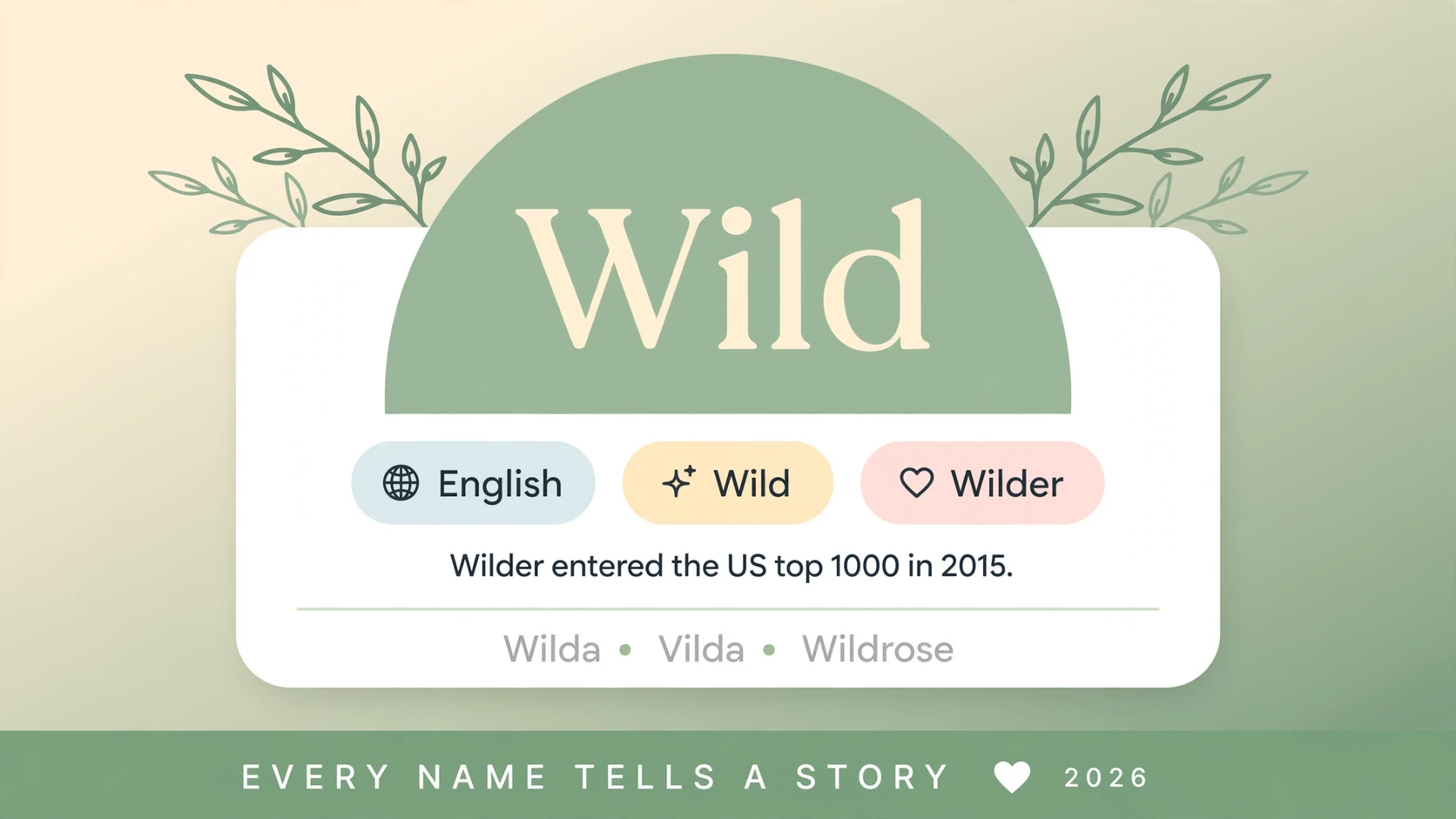
| 2015 | Wilder enters the United States top 1000 for boys and starts its remarkable modern run |
| 2020s | Wild names ride the nature name wave as parents trade soft classics for untamed spirit |
The Famous Bearers Who Gave Wild Its Shine
| Person | Field | Connection |
|---|---|---|
| Gene Wilder | Film | The beloved comic actor whose stage surname made wild feel warm and funny |
| Laura Ingalls Wilder | Literature | The Little House author whose surname will forever smell of prairie wind |
| Billy Wilder | Film | The legendary director whose razor wit matched his untamed surname |
| Thornton Wilder | Theater | The Our Town playwright who carried the name into American letters |
| Oscar Wilde | Literature | The Irish wit whose surname form Wilde turned wildness into pure style |
| Douglas Wilder | Politics | The Virginia governor who proved the name belongs in halls of power |
| Bear Grylls | Adventure | Born Edward Michael Grylls, his nickname Bear shows how wild names are earned |
| Storm Reid | Film | The young actress whose stormy first name rides the same untamed trend |
| Wilda Bennett | Stage | The early 1900s American actress who wore the vintage feminine form |
How Wild Climbed the American Charts
| Period | Trend Note |
|---|---|
| Late 1800s | Wilda appears in American records as nature names bloom in the romantic era |
| 1900 to 1940 | Wilda holds its vintage peak, familiar on school rosters across the Midwest |
| 1950 to 1990 | Wilda fades as sleeker mid century names take over, becoming a rare grandmother name |
| 2007 | Celebrity news gives Wilder its first push as a given name worth noticing |
| 2015 | Wilder breaks into the national top 1000 for boys, the official start of its modern run |
| 2016 | Wilder lands among the ten fastest rising boys names in the entire country |
| 2021 | Wilder reaches its highest national rank yet, cementing its place as a modern staple |
| 2020s | Vilda and Vilde gain quiet fans among parents hunting Scandinavian imports with real meaning |
| Late 2020s | Untamed baby name roundups regularly place Wilder among their most featured picks |
Nicknames That Keep the Untamed Spark
| Nickname | Vibe | Formality |
|---|---|---|
| Wild | Bold and literal | Best for close friends and family |
| Wills | Friendly and easy | Works in schoolyards and offices alike |
| Will | Classic and calm | The safe short form for Wilder and Wilda |
| Dee | Sweet and vintage | A playful clipping from the tail of Wilda |
| Villy | Bright and Nordic | A natural pet form for Vilda in Scandinavian homes |
| Rosie | Soft and floral | Drawn from the rose half of Wildrose |
| Wylie | Merry and western | A sound alike spelling some Wilder families adopt |
| Ari | Light and Greek | A gentle short form pulled from Agrios |
| Willie | Tomboy vintage | A retro short form from the early 1900s |
| Vee | Minimal and sweet | The first initial of Vilda and Vilde as a pet name |
Seven Spellings of Wild from Three Languages
| Variant | Culture or Region | Spelling Nuance |
|---|---|---|
| Wilder | English | The standard form, a surname turned modern first name for boys |
| Wilde | English | The trimmed surname form, sleek and literary |
| Wilda | English and German | The feminine coinage with a vintage American glow |
| Wildrose | English | The compound form, romantic and botanical |
| Wilderose | English | An alternate spelling of the compound with an extra e |
| Vilda | Swedish | Feminine form from Swedish vild, said with a long singing ee |
| Vilde | Norwegian and Danish | The masculine form across the North Sea, short and strong |
| Agrios | Greek | The classical form from agrios, rare and mythological |
| Wylda | English | An old fashioned spelling variant of Wilda with a y |
| Wild | English | The bare word form, the boldest and rarest choice of all |
Middle Name Pairings That Let Wild Breathe
| Pairing | Why It Flows |
|---|---|
| Wilder James | The steady classic James anchors the adventurous Wilder |
| Wilder Grey | Two soft syllables that sound like morning mist over open land |
| Wilda Rose | Vintage first name meets timeless flower, pure storybook charm |
| Wilda June | Short and sunny, June keeps the wildness light and wearable |
| Vilda Linnea | Two Scandinavian beauties that sing together in soft vowels |
| Vilde Anders | Strong Nordic pairing with matching crisp consonants |
| Wilde Alexander | Literary edge up front with regal balance in the middle |
| Agrios Dean | Ancient Greek fire cooled by a calm one syllable classic |
| Wildrose Mae | Botanical first name with a sweet old fashioned middle |
Sibling Sets That Roam Together Beautifully
- Wilder and Juniper, two nature names sharing the same free roaming energy
- Wilda and Flora, vintage sisters straight out of a wildflower meadow
- Vilda and Soren, Scandinavian siblings with soft strength and clear vowels
- Wilde and Pearl, one untamed and one polished, a perfect balance
- Wildrose and Hawthorn, botanical siblings with petals and thorns alike
- Agrios and Daphne, Greek myth siblings with ancient roots and bright sounds
- Vilde and Liv, short Nordic names that ring like a clear fjord morning
- Wilder and Scout, adventurous brothers ready for the open trail
- Wilda and August, a vintage pair with prairie warmth and staying power
Why Names That Mean Wild Speak to Modern Parents
You live in a time when parents trade safe classics for names with a pulse. Wild names promise a child who will climb the tree instead of merely admiring it, and that promise feels honest in a world of curated perfection.
The beauty is that the wildness lives entirely in the meaning. A little Wilder can be gentle as a lamb while carrying a name that roars, and that delightful contrast is exactly what makes these names so lovable.
The Quiet Scandinavian Branch of the Family
Across the North Sea the same ancient root took a softer shape. Swedish parents say Vilda with a long singing ee, and the name feels like wind moving through pine trees rather than a storm breaking over the hills.
Norway and Denmark answer with Vilde, a compact masculine form with the same untamed heart. If you love the meaning but want something rare on English speaking playgrounds, this quiet branch deserves your attention.
How to Wear a Bold Meaning Lightly
A strong meaning works best when the rest of the name stays easy. Pair Wilder with a calm middle like James, or soften Wilda with June, and the wildness reads as spirit rather than noise.
Nicknames do the same quiet work. A Wilder who goes by Wills at school keeps the full untamed name for the moments that matter, which is truly the best of both worlds.
Giving Your Little One a Name with Teeth
Some names whisper and some names grin. Wild names grin, and children tend to grow into that grin with surprising grace, as the famous Wilders of stage and page have shown for generations.
Trust your gut when you say the name out loud. If Wilder or Vilda makes you smile on the third try, that smile is the only permission slip you will ever need.
Frequently Asked Questions About Names That Mean Wild
Is Wilder a boy name or can girls wear it too?
Wilder ranks for boys in the United States, but its word name sound works beautifully for girls as well.
How do you pronounce Vilda?
Say VEEL dah, with the stress on the first syllable and a long ee sound.
Is Wilda too old fashioned for a baby in 2026?
Its vintage prairie charm is exactly what makes it fresh again, much like other grandmother names returning today.
What middle names pair best with Wilder?
Calm classics like James, Grey, or Thomas balance the untamed energy of Wilder perfectly.
Does the name Agrios really mean wild?
Yes, it comes from the Greek word agrios, meaning wild, and appears in ancient mythology.