
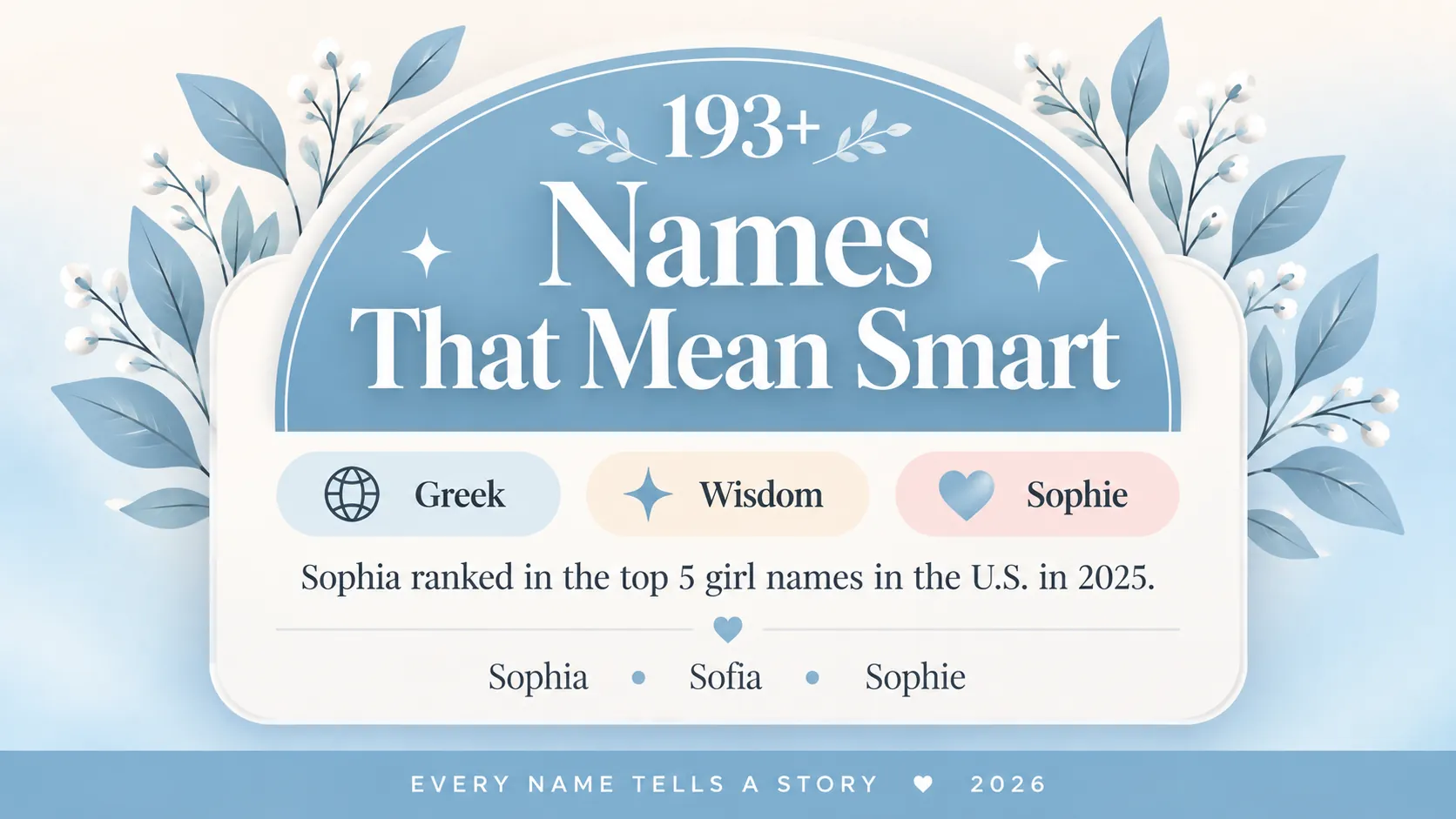
Names That Mean Smart come from ancient words for wisdom, thought, understanding, good judgment, knowledge, and intelligent counsel. Sophia comes from the Greek word sophia, meaning wisdom, while Hugo traces to the Old Germanic root hugu, meaning mind, thought, or spirit. These are not simply names that sound scholarly. Their histories actually connect them with qualities of the mind.
If you want your little one’s name to celebrate curiosity and thoughtful strength, you have choices ranging from familiar Sophia and Sage to distinctive Minerva, Medha, Vivek, and Cato. The best fit depends on whether you prefer literal intelligence, practical wisdom, or a subtler connection to learning.
From Sophia’s Wisdom to Hugo’s Thought
Some smart names translate directly to wisdom or intellect, while others carry neighboring ideas such as discernment, counsel, knowledge, or understanding. Knowing that distinction helps you choose a meaning that truly reflects what matters to you.
| Name | Root and core meaning | Naming style |
|---|---|---|
| Sophia | Greek sophia, wisdom | Classic feminine |
| Hugo | Germanic hugu, mind, thought, spirit | Classic masculine |
| Hugh | English form developed from Hugo | Traditional masculine |
| Sage | English word for a wise person | Gender neutral |
| Prudence | Latin prudentia, foresight and good judgment | Vintage feminine |
| Vivek | Sanskrit viveka, discernment and judgment | Masculine |
| Medha | Sanskrit medha, intelligence and wisdom | Feminine |
| Fahim | Arabic root associated with understanding | Masculine |
| Aqil | Arabic name associated with intelligence and reason | Masculine |
| Conrad | Germanic elements associated with bold counsel | Traditional masculine |
Sophia offers perhaps the clearest direct connection with wisdom. Hugo takes a different path. Instead of describing accumulated wisdom, its early Germanic root describes the mind and the act of thought itself.
Sage works differently again. The English noun refers to a person respected for wisdom and sound judgment, so its modern naming appeal feels both natural and intellectual.
Ancient Names That Carried Wisdom Through History
Names connected with intelligence are hardly a modern parenting trend. Several traveled through royal courts, religious traditions, mythology, philosophy, and medieval Europe long before appearing on today’s birth certificates.
| Name or tradition | Historical development |
|---|---|
| Sophia | Used in the ancient Greek and early Christian world as the word and name associated with wisdom |
| Sofia | A major European spelling of Sophia that spread across numerous languages |
| Hugh | Became established among Frankish and French nobility and entered England with the Normans |
| Hugo | Old Germanic form that remained especially strong across continental Europe |
| Minerva | Name of the Roman goddess strongly associated with wisdom, crafts, and intellectual skill |
| Prudence | Developed from the Latin virtue of practical judgment and foresight |
| Sage | English vocabulary name built from the older title for a wise person |
| Cato | Ancient Roman name traditionally connected with the Latin idea of shrewdness or wisdom |
| Vivek | South Asian given name grounded in the concept of discernment |
| Medha | South Asian feminine name linked with intellect, mental power, and wisdom |
Hugh provides one of the clearest examples of cultural travel. Its Germanic family was familiar among Frankish and French nobility, and the Normans helped establish Hugh firmly in medieval England.
Sophia followed a different route. Its direct meaning of wisdom gave it religious and philosophical depth, while royal families across continental Europe helped make it an enduring personal name.
Names That Mean Smart Across Languages and Cultures
The idea of intelligence does not translate into one single naming concept. Some traditions emphasize wisdom, others understanding, reason, counsel, discernment, or a thoughtful mind.
| Name | Cultural connection | Intelligence link |
|---|---|---|
| Sophia | Greek | Wisdom |
| Sofia | European and international | Wisdom |
| Sophie | French and international | Wisdom |
| Hugo | Germanic and European | Mind and thought |
| Hugh | English | Mind and spirit |
| Ugo | Italian | Mind and thought |
| Sage | English | Wise person |
| Prudence | English from Latin | Good judgment and foresight |
| Medha | Sanskrit tradition | Intelligence and wisdom |
| Vivek | Sanskrit tradition | Discernment |
| Fahim | Arabic | Understanding and intelligence |
| Aqil | Arabic | Intelligent and reasonable |
| Conrad | Germanic | Bold or brave counsel |
| Alfred | Old English | Counsel with an older compound meaning |
| Minerva | Roman | Wisdom association |
If you want a meaning that is extremely transparent in English, Sage and Prudence are easy to understand. Sophia feels more conventionally classic while still carrying an unusually direct meaning.
Hugo and Hugh suit parents who prefer an intellectual meaning that is less obvious on the surface. Their historical root points toward mind and thought rather than simply labeling the bearer wise.
Sophia, Sage, Hugo, and the Modern Popularity Story
Current American usage shows that names associated with intelligence can sit at very different popularity levels. Some are mainstream favorites, while others remain uncommon enough to feel distinctive.
| Name | Recent U.S. pattern |
|---|---|
| Sophia | Ranked number 5 for girls in 2025 |
| Sofia | Ranked number 9 for girls in 2025 |
| Sophie | Ranked number 55 for girls in 2025 |
| Sage for girls | Ranked number 160 in 2025 |
| Hugo | Ranked number 378 for boys in 2025 with 837 births |
| Sage for boys | Ranked number 456 in 2025 |
| Hugh | Remains an established but less common traditional choice |
| Minerva | Historically familiar in the United States but far rarer today |
Sophia’s continued strength is especially striking because parents do not have to choose between meaningful and familiar. Sofia gives you almost the same sound with an internationally widespread spelling, while Sophie feels lighter and more compact.
Hugo has also been moving within the American Top 1000 while remaining much less common than Sophia. Its combination of European history, concise spelling, and the meaning mind or intellect gives it a distinctive position among boy names.
Famous Minds and Cultural Figures Behind the Names
Not every person with one of these names became famous for intellectual achievement, of course. Still, notable bearers help show how long and widely these names have been used.
| Bearer | Known for | Name connection |
|---|---|---|
| Victor Hugo | French novelist and poet | Hugo reflects the old Germanic mind and thought root |
| Hugo Gernsback | Publisher and science fiction pioneer | Helped make Hugo recognizable in literary and scientific culture |
| Hugo Weaving | Actor | Modern international bearer of Hugo |
| Hugo Lloris | French footballer | Contemporary European bearer |
| Hugh Capet | King of France | Important medieval bearer of the Hugh name family |
| Hugh of Lincoln | Medieval bishop and saint | Helped strengthen Hugh’s use in England |
| Sophia Loren | Italian actress | One of the most internationally recognized Sophia bearers |
| Sofia Coppola | American filmmaker | Prominent modern Sofia bearer |
| Minerva | Roman goddess | Cultural symbol of wisdom, craft, and strategic thought |
Victor Hugo gives Hugo tremendous literary presence even though Hugo was his family name rather than his personal name. The association has nevertheless helped keep the word familiar around the world.
Minerva is especially interesting because the intellectual connection is mythological as well as linguistic. The Roman goddess represented wisdom and skilled thought, making the name particularly appealing to parents who enjoy classical mythology.
Nicknames and Variants with Different Personalities
Variants can completely change the style of a wisdom name without losing its historical family connection. Sophia’s family is especially flexible, while Hugo and Hugh offer several European forms.
| Full name | Variant or nickname | Feel |
|---|---|---|
| Sophia | Sophie | Sweet and polished |
| Sophia | Soph | Casual and modern |
| Sophia | Sofia | International and streamlined |
| Sophie | Soph | Friendly and compact |
| Hugo | Hugh | Traditional and understated |
| Hugo | Ugo | Italian and distinctive |
| Hugo | Hugues | French historical form |
| Hugh | Hughie | Warm and playful |
| Minerva | Minnie | Vintage and approachable |
| Minerva | Mini | Light and modern |
| Prudence | Pru | Crisp and confident |
| Prudence | Prue | Traditional short form |
| Sage | Sage | Usually kept unchanged |
Sophia gives you the greatest flexibility if nicknames matter. Your daughter can move naturally between Sophia, Sophie, and Soph depending on age and personality.
Prudence has almost the opposite effect. The formal name sounds substantial and vintage, while Pru or Prue feels brisk, friendly, and surprisingly contemporary.
Names That Mean Smart with Beautiful Middle Name Rhythm
When the first name already carries a strong intellectual meaning, a middle name can soften, strengthen, or modernize the full combination.
| Pairing | Why it flows |
|---|---|
| Sophia Claire | The longer Sophia meets a crisp one syllable middle |
| Sophia Jane | Classic rhythm with uncomplicated warmth |
| Sofia Rose | Soft vowels followed by a short floral middle |
| Sophie Grace | Familiar, gentle, and balanced |
| Hugo James | Two strong traditional names with clean rhythm |
| Hugo Alexander | Short first name balanced by a longer middle |
| Hugh Benjamin | Compact Hugh gains warmth from a three syllable middle |
| Sage Elizabeth | Modern Sage is grounded by a classic middle |
| Sage Amelia | A concise first name flows into a softer vowel rich middle |
| Minerva Jane | Elaborate Minerva becomes easier and brighter with Jane |
| Prudence Mae | Vintage first name paired with a compact middle |
| Medha Rose | A meaningful international choice with a familiar middle |
Rhythm matters more than following a rigid naming rule. Short first names such as Hugh and Sage often benefit from longer middles, while Sophia and Minerva can sound beautifully complete beside a one syllable choice.
You can also use the middle position for a family name. A personally significant middle often adds more lasting value than choosing another name purely because its dictionary meaning matches.
Sibling Sets Built Around Wisdom and Thought
- Sophia and Hugo pair direct wisdom with the Germanic idea of mind and thought, while both names feel established internationally.
- Sofia and Leo create a warm European sound with similarly clean, easy spellings.
- Sophie and Clara feel light and classic without sounding overly formal as a sister set.
- Hugo and Felix share compact European styling and energetic endings.
- Hugh and Alice make a quiet traditional pairing that feels familiar without being trendy.
- Sage and Rowan work well if you love gender neutral nature influenced naming.
- Minerva and Helena create a stately classical set with strong ancient associations.
- Prudence and Beatrice have vintage depth and built in nickname possibilities.
- Medha and Vivek connect through concepts of intelligence, wisdom, and discernment.
- Hugo and Sophia balance a thoughtful Germanic meaning with a direct Greek wisdom meaning.
How to Choose Among Names That Mean Smart
Start by deciding what kind of intelligence you want the name to symbolize. Wisdom is not exactly the same as quick cleverness, and discernment is different again. Sophia expresses wisdom directly, Hugo centers on mind and thought, while Vivek emphasizes the ability to distinguish and judge well.
That subtle difference can make your shortlist much more personal. A family that values reflection might love Hugo. If you hope to honor good judgment, Prudence or Vivek may feel more meaningful. For a broad, unmistakable wisdom connection, Sophia remains hard to overlook.
You should also consider how obvious you want the meaning to be. English speakers immediately understand the intellectual association behind Sage, whereas Hugo’s meaning is hidden inside its Germanic history.
Neither approach is stronger than the other. One gives your child an instantly recognizable symbolism, while the other leaves a deeper story for you to tell when someone asks how you chose the name.
Why Sophia Still Defines the Wisdom Name Family
Sophia has endured because its meaning and sound reinforce one another beautifully. Its Greek root means wisdom, yet the name does not feel like a vocabulary lesson. Centuries of European use transformed it into a familiar personal name in its own right.
Sofia and Sophie also let you choose the version that best suits your family. Sofia feels especially international, Sophie is concise and friendly, while Sophia carries the fullest classical form in contemporary American usage.
Its popularity does mean Sophia will rarely feel unusual. For some parents that familiarity is reassuring, while others may prefer Minerva, Medha, or Prudence if distinction matters more.
The important point is that Sophia’s wisdom meaning is genuine rather than a modern interpretation attached to an unrelated name. That historical clarity explains why it appears so consistently in carefully researched smart name collections.
Hugo and Hugh Bring Intelligence to Boy Names
Many traditional boy names describe warriors, rulers, protection, or strength. Hugo stands apart because its Germanic root hugu points to mind, thought, and spirit. That gives it intellectual substance without making the name sound overtly scholarly.
Hugh developed from the same historical family and became particularly established in England after Norman influence. Hugo remained widely at home across continental European languages and later gained broader English language use.
If you like short names, both are practical. Hugh is spare and traditional, while Hugo has a warmer, more international sound because of its final vowel.
Pair Hugo with James, Alexander, Thomas, or Benjamin for a conventional full name. Hugh also works particularly well when you want the first name to stay restrained and let a longer middle carry more of the rhythm.
Smart Does Not Have to Mean Academic
A meaningful name can celebrate qualities much broader than grades or academic achievement. Traditional ideas of wisdom often include patience, sound judgment, understanding, thoughtful speech, and knowing when to reconsider a decision.
That is why Sage, Prudence, Vivek, and Sophia do not all mean exactly the same thing. Each highlights a different dimension of an intelligent life, from learned wisdom to discernment and practical judgment.
You may also prefer a name with a cultural association rather than a literal translation. Minerva is a good example because its connection with the Roman goddess places wisdom, craftsmanship, and strategy at the center of its story.
Choose the interpretation that feels most meaningful to your family. Your little one’s personality will eventually give the name a definition far richer than anything found in an etymology book.
Faqs About Names That Mean Smart
Does Sophia really mean wisdom?
Yes. Sophia comes directly from the Greek word sophia, meaning wisdom, and this meaning has remained central to the name throughout its history.
Does Hugo actually mean smart or intelligent?
Hugo comes from a Germanic root meaning mind, thought, or spirit, so intellect is a reasonable interpretation, though mind and thought are more precise.
Is Sage a boy or girl name in the United States?
Sage is used for both genders, though 2025 U.S. data shows it ranking higher for girls than for boys.
Is Minerva literally a name meaning wisdom?
Minerva is most securely associated with wisdom through the Roman goddess, while the exact linguistic origin of the name itself remains debated.
Which middle names sound best with Sophia and Hugo?
Short classics such as Sophia Claire and Hugo James flow easily, while longer choices such as Hugo Alexander create a balanced traditional rhythm.